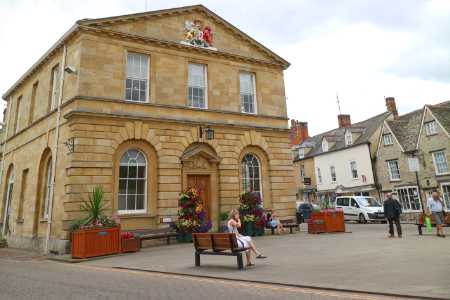
William Morris & Family - Part 1 - Cotswolds Legacy
You are here: Home > Cotswold Blog > William Morris & Family - Part 1 - Cotswolds Legacy
During my walk of the Costwold Canals and Thames Path, William Morris's name came up in my travels and blog research several times. I had previously noted his association with Bibury, and was surprised to read he often visited Avebury and Silbury Hill, which I myself visited last summer. On reading his history further, it turns out that while being born and working in London, he fell in love with the Cotswolds.

William Morris, a revolutionary writer, artist, and architectural conservationist, is credited with founding the Arts and Crafts Movement in the 19th Century.
He pioneered much greater creatively in decorative arts, and later in life became a social activist changing ideologies of the era. His main connection to the Cotswolds was his second family home in Kelmscott Manor near Lechlade-on-Thames.
This blog explains the influence that this summer home and the Cotswolds had on him, his surviving legacy, and the generous acts of his wife and daughter.
I visited Kelmscott, in January 2022, and again early March. I walked through the village and along the footpaths / fields that William may have walked. I stopped at points along the River Thames where he may have fished, and witnessed the Morris family's legacy and resting place first-hand. I will do a part 2 blog about his life in London, and his works, though include some necessary highlights here for context.
About William Morris
William Morris was born in Walthamstow, London in 1834, the family with eight children moving to Woodford Hall, Essex in 1840. An early influence for William was a childhood growing up and playing in the countryside. He developed an interest in the wildlife, landscapes and particularly flowers which he increasingly portrayed in his design and artwork. From 1848 he studied at the private Marlbourgh College where he visited nearby prehistoric sites of Wiltshire, such as Avebury and Silbury Hill (these are 25 miles from the Cotswolds southeast boundary).
He attended Exeter College at Oxford University from 1852, reading Theology and forming a group of friends known as the Birmingham Set. Notably with Edward Burne-Jones, with who he became life-long friends, there was a desire to address a lack of creativity in decorative Arts. Influenced by the romantic poetry of Keates and Shelly, and the philosophy of John Ruskin, which favoured hand-craftsmanship, they created a new radical movement. This aimed to reform that which went before in the industrial era.
William became extremely interested in Medieval history and architecture, inspired by the historic buildings in Oxford. Graduating in 1856 he began an architectural apprenticeship with neo-Gothic Architect George Edmund Street. Initially based in Oxford, then the London office, he was supervised by a young Architect called Philip Webb. In London he shared a flat with Edward Burne-Jones who was an apprentice with acclaimed Pre-Raphaelite artist Dante Gabriel Rossetti. The four of them became good friends and together Morris, Rossetti and Burne-Jones painted the Arthurian murals at the Oxford Union.
https://oxford-union.org/history-and-pre-raphaelite-murals/
William met Jane Burden in 1857, who was modelling for Rossetti. They married in 1859, and had two daughters in the early 1860s. Until 1865 they lived in 'The Red House' now a National Trust Property in Kent, moving to a flat above the then business premises in Queen Square, London until 1873. By 1870 William was a public figure, and he searched for a house outside London for his children to spend time away from the cities pollution, renting Kelmscott Manor as featured below. After 6 years at Horrington House, Chiswick, in 1879 he moved the families London home to a Hammersmith mansion alongside the River Thames. He named this Kelmscott House, which is now owned by the William Morris Society, with a museum in his name.
William Morris's Business
William set up his business Morris, Marshall, Faulkner & Co. in 1861 with six other partners inc. Burne-Jones, Rossetti & Webb. Operating initially from Holburn in London they referred to themselves as "the Firm", producing furniture, architectural carvings, metalwork, murals, and notably stained-glass windows. From 1862 William Morris specialised in wallpaper design, which feature on products made in his name available at shops in the Cotswolds.

Morris assumed full control of the firm in 1875, which continued to trade as Morris & Co until 1940. Alongside his work for the firm, Morris also fell in love with Iceland, producing a series of English-language translations of Icelandic Sagas. In 1891 the influence of his summer home continued, when he founded a company to publish limited-edition illustrated books, and called it the Kelmscott Press. His legacy even influenced the editors of Country Life Magazine. The extract below is taken from https://owlpen.com/arts/cotswold-houses
His appreciation of the Cotswolds and his plea for its vernacular buildings was transmitted to the aesthetic of the early editors of Country Life magazine in the 1890s. Country Life recorded how William Morris and Philip Webb 'had been voices crying in a wilderness of prejudice and ignorance the claims of [the] heritage to appreciation (March 1916).
Christopher Hussey (1 December 1934) was to see in Morris the man who more than any other individual, first directed attention to the austere poetry, the supreme if undemonstrative craftsmanship, of Cotswold architecture.'
Avebury World Heritage Site
The area around Avebury in Wiltshire is a World Heritage Site, and a Site of Special Scientific Interest. It contains Neolithic and Bronze Age Monuments and was a significant place for prehistoric people to build earth, timber and stone structures for over 2,000 years.

Avebury Stone Circle
Dated to between 2850 BC and 2200 BC, there is a circular bank and ditch, encircling part of Avebury village. Inside is the largest stone circle in Britain, which in turn encloses two smaller stone circles.
Silbury Hill
This is the largest artificial mound in Europe, with similar dimensions to the Egyptian pyramids. Built around 2400 BC, it does not appear to be a burial mound, in fact its purpose remains unknown.


Credit: Picture kindly provided for use by the Society of Antiquaries of London
Kelmscott Manor & House
When William Morris first laid eyes on Kelmscott Manor he fell in love with it, citing it as 'heaven on earth'. It and the adjoining farm buildings were true to his love of old craftmanship and harmonised with the surrounding countryside. Kelmscott Manor dates from around 1570, with a 17th-century wing. It's Grade I listed and has a dovecote, barns and a garden cottage.
In 1871 William entered into a joint tenancy with Rossetti. In part this was due to him taking a difficult choice to tolerate, and try to make discreet, an affair between his wife and Rossetti. She had continued to model for Rossetti, and William was spending long periods in Iceland, his other favoured retreat. This summer home which Morris still called the 'loveliest haunt of ancient peace' provided inspiration for him and his friends to create pieces of art.
His wife Jane continued to live in Kelmscott after Williams death in 1896. She commissioned two houses, Memorial Cottages, in William's memory with the carved stone memorial pictured earlier. She bought Kelmscott Manor in 1914 shortly before her death. More information here https://www.nationaltrust.org.uk/red-house/profiles/janey-morris
Their daughter May was gifted herself running the embroidery arm of Morris & Co. She became very involved in Kelmscott village life, founding and acting as president of the WI. She commissioned Ernest Gimson who was mentored by her father, to build another pair of houses, and to design a village hall. The First World War, and Gimson's death in 1919, delayed the building of the hall until 1934. More information here https://www.nationaltrust.org.uk/red-house/profiles/may-morris
With May now a permanent resident, the Village Hall opening was attended by over 300 people, with George Bernard Shaw, an associate of Morris's socialist period making an opening speech. The Prime Minister, Ramsay MacDonald, surprised everyone by attending.
May was still living in Kelmscott Manor until her death in 1938 and bequeathed the house and estate to Oxford University, on the basis the contents were preserved and the public were granted access. They in turn passed it onto the Society for the Protection of Antiquities who honoured her wishes.
In a shaded area of Kelmscotts' Parish Church, St Georges, is the family tombstone designed by Philip Webb. It was a little overwhelming seeing all for names engraved on the stone when I visited.
The Manor House still contains furniture, pictures, paintings, ceramics and metalwork by Morris and his colleagues, that demonstrate their passion and skill. It is currently closed for National Lottery Funded renovation and creation of a new educational building for young persons and will re-open in April 2022.
St John The Baptist Churches, Burford and Inglesham
In 1876, William visited St John the Baptist, Burford where he was appalled by the restoration carried out by his former employer George Edward Street. The movement of the time was to strip out genuine old features, and replace them with what he called 'sham old' features. This inspired him to set up the Society for Protection of Ancient Buildings (SfPoAB). His 1877 manifesto saying 'to stave off decay by daily care, and otherwise resist all tampering with either the fabric or ornament of the building as it stands'.

As close to Kelmscott, William Morris campaigned to save St John the Baptist Inglesham from unsympathetic restorations. Much of the church was built early 13th century, containing some parts of an earlier church. Unlike many others that had Bell Towers added, it retains its 13C double belcote.
Through the SfPoAB he arranged a survey of the church, obtained funding, and J.T. Micklethaite was employed to oversee the works, mainly limited to the roof. More here William Morris Letters. The restoration ensured the following interior features were preserved.
- 11C carvings from previous church
- 13C marble floor slabs, reredos and piscina
- Wall paintings 13 to 19 century
- 15C font and parclose screens
- 6C pulpit and 17/18C box pews
Religious activities became redundant in 1979, and the church was vested in what is now the Churches Conservation Trust. It is kept open for the public to visit, more here https://www.visitchurches.org.uk/visit/church-listing/st-john-inglesham.html

Bibury
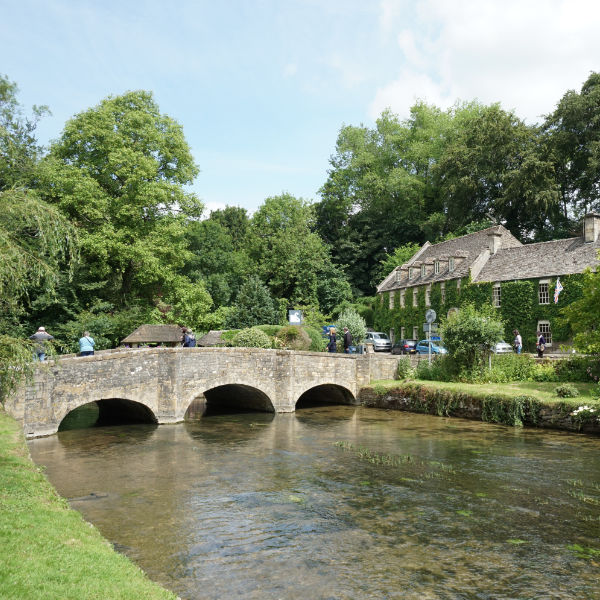
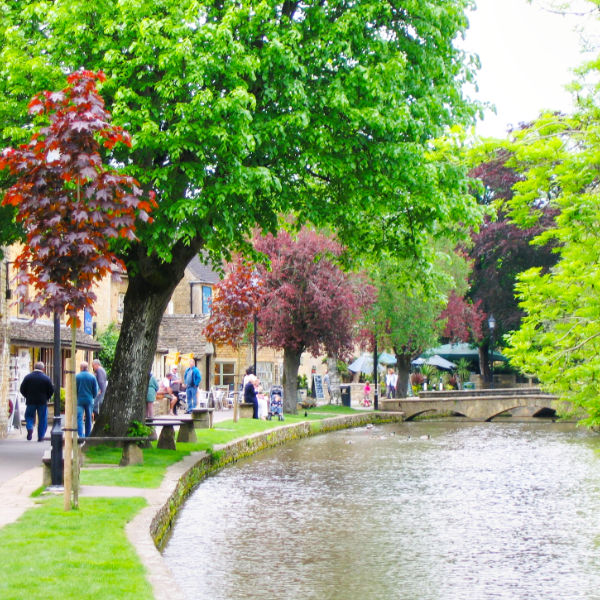
Bibury was another place that greatly inspired the works of William Morris. He loved Bibury so much, that he described it as 'the most beautiful village in England'.
His influence is still present there today. The National Trust, who own Bibury's key landmark Arlington Row, refer to his quote on their website. It is also cited in many Tourist Guides.
Some of his art, in the form of kitchen ware decorated with his wallpaper patterns and designs, can be purchased from the Bibury Trout Farm shop. (pictured earlier).
Broadway Tower (designed by Capability Brown)
William Morris became aware of Broadway Tower when his old friend from the 'Birmingham Set' Cormell Price leased it.
William, Rossetti and Edward, along with other members of the Arts and Crafts Movement, used the Tower as a country holiday retreat. He also took his wife and children to enjoy the views.
It is believed Morris's campaign for the preservation of historic monuments was started during one of these stays, and he penned the letter here that led to the SfPoAB being established. Today the Tower publicises that association, and its links to the Arts and Crafts movement. It has an interactive display of Morris and Arts and Crafts on site, and the Morris and Brown cafe and shop.


William Morris College
William Morris College was established in 1978 with the specific aim of helping young people with learning difficulties and other complex needs to manage the transition between school and adult life. An independent not-for-profit establishment run by the Novalis Trust, it offers 16-25-year-olds a specialist further education, with day and residential boarding places. The colleges website explains:
The college is the namesake of William Morris, whose creativity and wide-ranging talents made him one of the most significant figures of his era.
In the same way that William Morris' work as an artist, designer, craftsman and writer changed the ideologies and fashions of Victorian Britain, our carefully designed courses offer a fresh and innovative approach to helping our students acquire the skills they need for adult life.
William Morris beyond the Cotswolds
I have discovered in my travels and research that William Morris' legacy in the Cotswolds is widespread and extends to tourism, notable landmarks, preservation of historic buildings and specialist further education. His family honoured his commitment to conservation, donating Kelmscott House for the public to see, and providing housing and community facilities in Kelmscott.
I now want to find out more about his works and businesses, and his legacy in London, and do so in person for an authentic part 2 of this blog. Kelmscott Manor, opens in April so I will visit to give me pointers. There also the William Morris Gallery in Walthamstow, London to visit. And since I am walking the Thames Path, I can l combine that with a visit to Kelmscott House in Hammersmith, taking in its museum. Who knows as my adventure evolves, a third blog may result?
Last updated: 23 August 2023